Qoryvexal
Free Capsule
Free Capsule
Couldn't load pickup availability
-
Problem Statement
Starting Java can feel confusing when topics appear in a scattered order. New learners often meet variables, classes, methods, and logic rules before they understand how these ideas connect. Many study materials move from one topic to another without giving enough room for practice. This can make learners memorize terms instead of understanding how code works. Free Capsule was created to give a smaller, cleaner beginning before moving into larger Qoryvexal courses. -
Solution
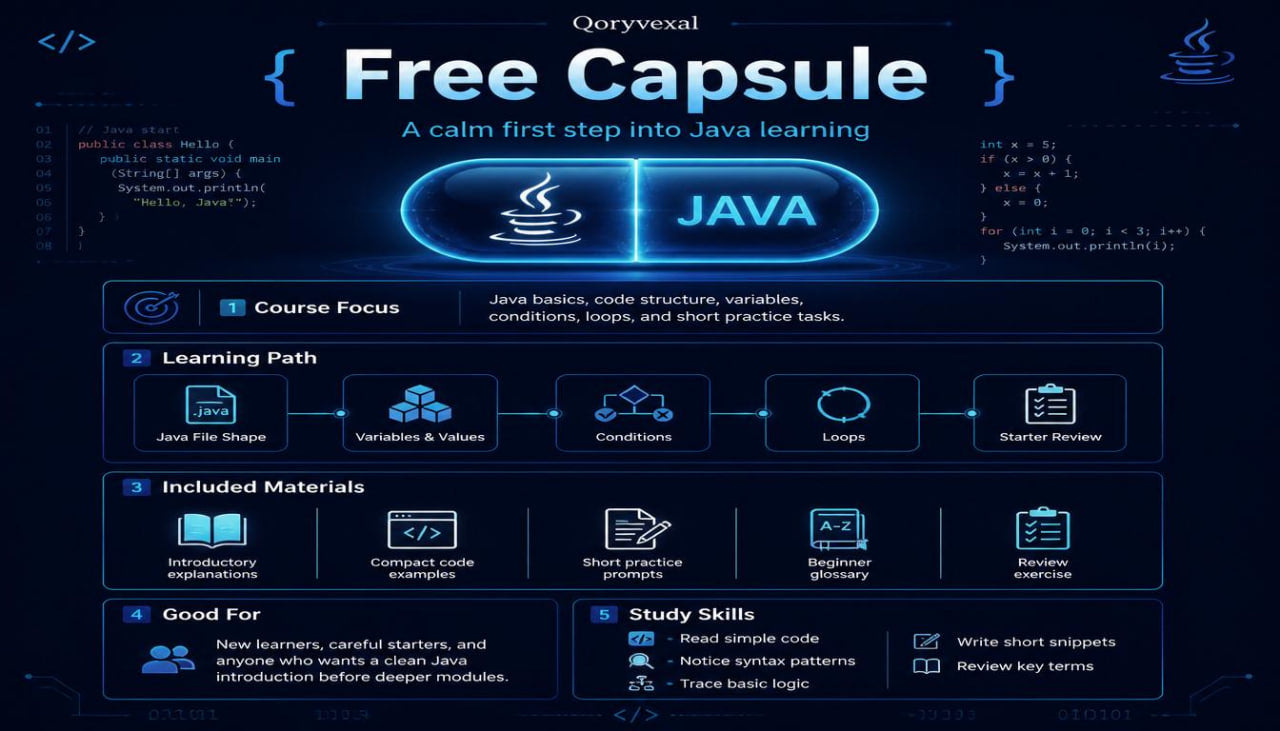
Free Capsule gives learners a focused introduction to Java basics through organized starter materials. The course begins with simple concepts and connects each idea to a small coding example. Instead of overwhelming learners with too many topics at once, it keeps attention on the first building blocks. Each section is written to help learners read code, notice patterns, and try small exercises. This makes Free Capsule a helpful first step before choosing a deeper Java course path. -
What’s Inside
Free Capsule includes a compact Java starter module with introductory explanations, short examples, and guided practice tasks. Learners begin with the idea of how Java code is structured, including classes, methods, statements, and basic syntax. The materials then move into variables, simple data types, operators, and how values are used inside small code examples. A separate section introduces conditional logic, showing how code can follow different branches based on clear rules. Another part explains loops in a simple way, with examples that repeat actions and help learners see how patterns work in code.
The course also includes small reading tasks that ask learners to look at code and explain what each part does. These tasks are designed to build careful observation rather than guessing. Practice prompts are included after each topic, so learners can write small snippets and compare their thinking with the example flow. Free Capsule also gives a short glossary of beginner-friendly Java terms, helping learners return to key ideas when needed. The final part includes a small review exercise that combines variables, conditions, and loops into one simple coding task.
-
Who is this for?
Free Capsule is for learners who are new to Java or want a clean refresher before moving into broader materials. It is also useful for people who prefer a calm introduction before working with longer modules. This tariff fits learners who want to understand the basic shape of Java code without pressure or exaggerated claims. It can also help those who tried Java before but found the first steps unclear. Free Capsule is a light starting point for exploring how Qoryvexal teaches. - What You’ll Learn
- How a simple Java file is organized
- What classes, methods, and statements are used for
- How variables hold values in small examples
- How basic data types appear in beginner code
- How operators work in simple expressions
- How conditional logic changes code flow
- How loops repeat actions in a controlled way
- How to read small Java snippets with more clarity
- How to complete short practice tasks after each topic
- How Qoryvexal structures Java learning materials
-
Refund Note
Free Capsule has no fee, so no payment refund applies to this tariff. For paid Qoryvexal courses, learners may request a refund within 30 days according to the store refund policy.
Self-paced learning overview
- 📘 Digital file available after purchase
- ♾️ Long-term availability
- 🔒 Secure checkout
- 🗓️ Content updated in 2026
What is Qoryvexal focused on?
What is Qoryvexal focused on?
Qoryvexal is focused on Java learning through structured modules, practical tasks, and clear study materials. The courses are made to help learners understand Java concepts step by step and apply them in coding exercises.
Do I need previous Java knowledge before starting?
Do I need previous Java knowledge before starting?
No previous Java background is required for the starter materials. Some courses are made for new learners, while later options may include deeper topics, larger exercises, and more detailed coding practice.
How are the materials organized?
How are the materials organized?
The materials are grouped by topic, with explanations, examples, exercises, and review points. Each course is shaped to help learners follow a steady study path without exaggerated claims or pressure-based language.
Share