Qoryvexal
Drift Pattern
Drift Pattern
Couldn't load pickup availability
-
Problem Statement
Many Java learners reach a point where single examples feel clear, but longer exercises become difficult to follow. Code can drift out of focus when loops, conditions, arrays, and methods appear together in one task. Learners may know the terms, yet still feel unsure about the order in which code should be written. It can also be hard to recognize repeated patterns inside different exercises. Drift Pattern was created to give learners a guided way to study how Java code moves, changes, and connects. -
Solution
Drift Pattern focuses on the movement of Java code from the first instruction to the final result. The course shows how values are created, checked, changed, passed into methods, and used inside repeated structures. Each module introduces a pattern, explains it through a small example, and then gives learners a related task with slight variation. This helps learners notice how similar logic can appear in different forms. The course supports steady Java practice through observation, writing, review, and correction. -
What’s Inside
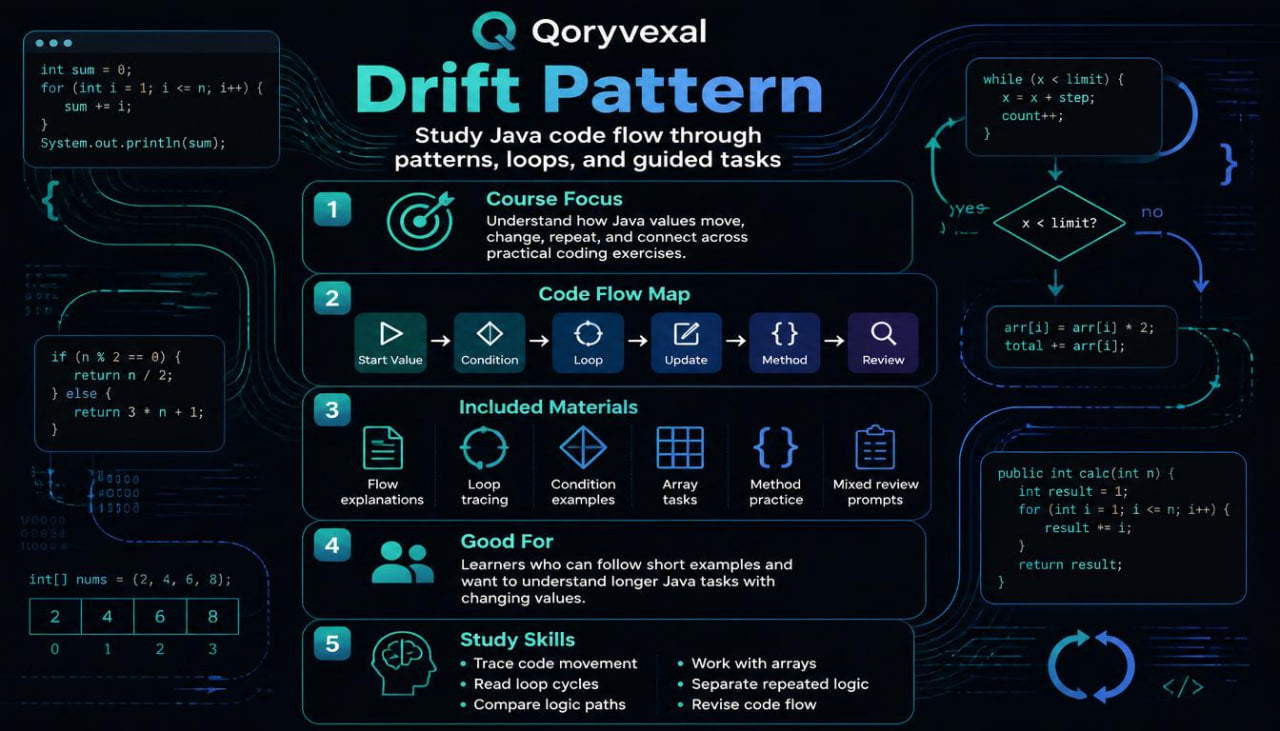
Drift Pattern includes a detailed set of Java modules focused on flow control and reusable coding patterns. The opening part reviews how Java code runs from top to bottom and how statements create a clear sequence of actions. Learners study examples where values are declared, updated, compared, and printed, with notes explaining each step of the process.
The next section focuses on conditions and branching. Learners work with comparison checks, logical operators, nested conditions, and multi-branch structures. The materials include tasks where code chooses between different actions based on numbers, text, or stored values. Learners also review examples where conditions are written in different ways, then compare which version is clearer.
A major part of Drift Pattern is dedicated to loops. Learners study counting loops, condition-based loops, value accumulation, repeated checks, and loop stopping points. The course includes tracing exercises where learners follow variable changes through each cycle. These activities help learners understand how repeated actions can produce different results depending on starting values and conditions.
The course then moves into arrays and grouped values. Learners practice reading elements, updating positions, counting matches, searching for values, and combining array work with loops. Each topic is paired with small exercises that show how repeated data can be handled through clear logic.
The method section explains how repeated patterns can be placed into smaller named blocks. Learners review parameters, return values, local variables, and method calls. Tasks ask learners to identify repeated logic, separate it into methods, and describe the purpose of each part in plain language.
The final part includes mixed practice activities. Learners combine conditions, loops, arrays, and methods inside guided exercises. Review prompts ask them to trace code, describe code flow, revise naming, and explain why a result appears. This gives Drift Pattern a practical rhythm centered on reading, writing, and refining Java logic.
-
Who is this for?
Drift Pattern is for learners who already know basic Java syntax and want to understand code flow with more care. It fits people who find longer tasks harder than short examples. The course is useful for learners who want more practice with loops, conditions, arrays, and methods working together. It also suits those who like pattern-based study and guided review. Drift Pattern is a good fit for learners who want to improve how they read and plan Java code. - What You’ll Learn
- How Java code moves through a sequence of actions
- How values are created, updated, and checked
- How conditions shape different code paths
- How nested conditions work in practical examples
- How loops repeat actions with changing values
- How to trace variables through each loop cycle
- How arrays store and organize grouped values
- How loops and arrays work in shared tasks
- How methods separate repeated logic
- How parameters and return values support method-based code
- How to find patterns inside different Java exercises
- How to revise small code sections for clearer flow
-
Refund Note
Drift Pattern includes a 30-day refund period under the Qoryvexal store policy. Learners may review the course materials during this period and contact the support team if the course does not match their study needs.
Self-paced learning overview
- 📘 Digital file available after purchase
- ♾️ Long-term availability
- 🔒 Secure checkout
- 🗓️ Content updated in 2026
What is Qoryvexal focused on?
What is Qoryvexal focused on?
Qoryvexal is focused on Java learning through structured modules, practical tasks, and clear study materials. The courses are made to help learners understand Java concepts step by step and apply them in coding exercises.
Do I need previous Java knowledge before starting?
Do I need previous Java knowledge before starting?
No previous Java background is required for the starter materials. Some courses are made for new learners, while later options may include deeper topics, larger exercises, and more detailed coding practice.
How are the materials organized?
How are the materials organized?
The materials are grouped by topic, with explanations, examples, exercises, and review points. Each course is shaped to help learners follow a steady study path without exaggerated claims or pressure-based language.
Share