Qoryvexal
Anchor Deck
Anchor Deck
Couldn't load pickup availability
-
Problem Statement
After the first stages of Java study, learners often need a stronger point of reference. They may understand separate examples, but feel unsure when several concepts appear in one coding task. Methods, classes, arrays, and loops can become harder when they need to work together. Learners may also struggle with organizing code in a readable way. Anchor Deck was created to give learners a grounded Java course with repeatable patterns and guided practice. -
Solution
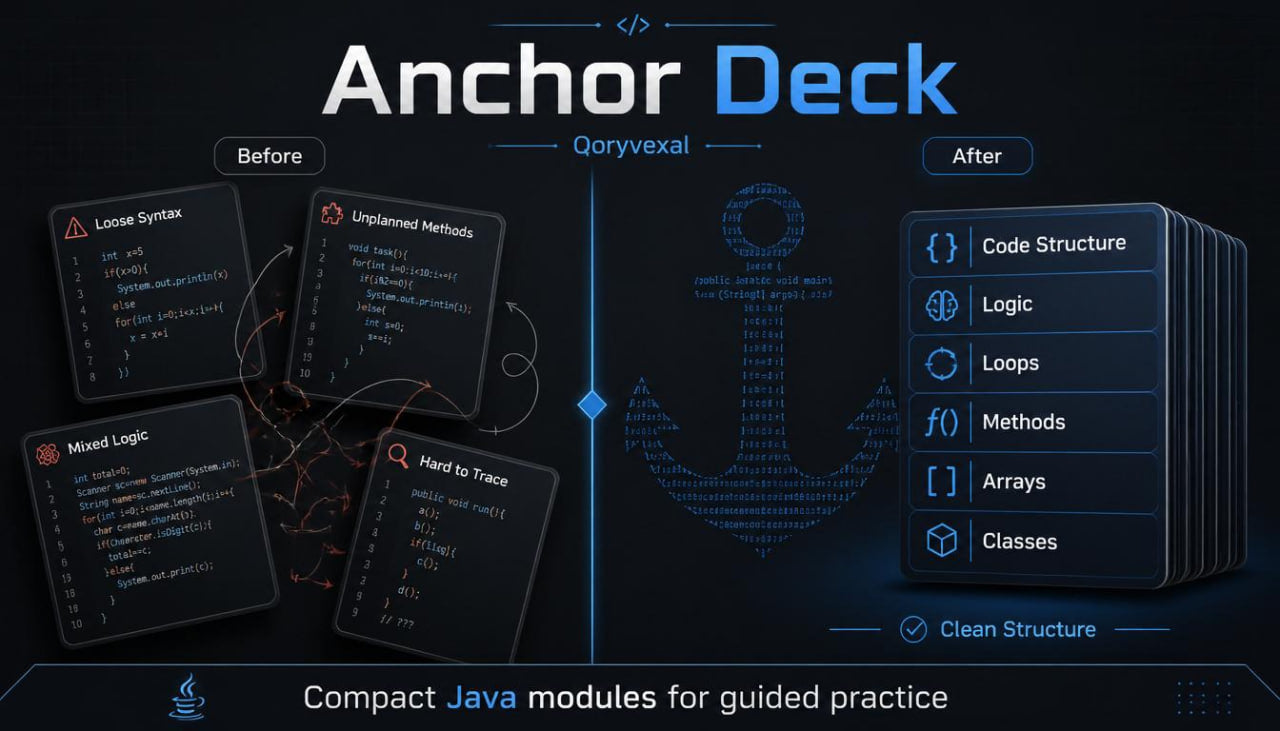
Anchor Deck gives learners a stable route through Java fundamentals and early object-oriented concepts. The course uses a deck-style structure, where each module focuses on one important topic and connects it to earlier material. Learners study explanations, read sample code, complete exercises, and review how each concept supports the next part. The course is shaped to help learners slow down, observe code carefully, and write small solutions with purpose. This makes Anchor Deck a practical bridge between beginner material and larger Java tasks. -
What’s Inside
Anchor Deck includes a focused set of Java modules arranged around core programming patterns. The first module reviews code structure, including classes, methods, statements, naming, and simple output. Learners revisit variables, data types, operators, and value changes through examples that show how small code pieces form a working task.
The second module explores conditional logic. Learners study comparison operators, logical checks, nested conditions, and multi-branch decisions. The materials include exercises where learners compare values, choose between code paths, and rewrite conditions in a cleaner form. Each activity is paired with short explanation notes, helping learners see why the code behaves as it does.
The next section focuses on loops. Learners work with repeated actions, counters, changing values, and stopping conditions. Practice tasks include number ranges, text handling, repeated checks, and value accumulation. Learners also trace loop behavior line by line, which helps them understand how data changes during execution.
A central part of Anchor Deck covers methods. Learners study parameters, return values, local variables, and how methods divide larger tasks into smaller sections. Exercises ask learners to turn repeated logic into reusable method structures. The module also includes code-reading prompts where learners describe the role of a method before writing their own version.
The course then moves into arrays and grouped values. Learners practice storing multiple values, reading elements, updating items, and combining arrays with loops. The exercises are designed to show how grouped data can be handled with organized code.
The final modules introduce class-based thinking. Learners study fields, constructors, object methods, and simple relationships between data and behavior. They create small class examples and review how objects represent information inside Java code.
-
Who is this for?
Anchor Deck is for learners who know some Java basics and want a steadier practice path. It fits people who want to connect syntax, logic, methods, arrays, and classes in one organized course. It is also useful for learners who need more code-reading practice before writing larger exercises. This tariff suits people who prefer compact modules with focused tasks. Anchor Deck works well for learners who want to develop Java skills through steady repetition and guided examples. - What You’ll Learn
- How to organize simple Java code with clearer structure
- How variables and data types appear in practical tasks
- How conditions guide different code paths
- How loops repeat actions and handle changing values
- How to trace code behavior line by line
- How methods use parameters and return values
- How to divide repeated logic into smaller method sections
- How arrays store and update grouped values
- How loops and arrays work together
- How fields, constructors, and object methods are used
- How to read class-based Java examples
- How to combine several Java topics in one exercise
-
Refund Note
Anchor Deck includes a 30-day refund period under the Qoryvexal store policy. Learners may review the course materials during this period and contact the support team if the course does not match their study needs.
Self-paced learning overview
- 📘 Digital file available after purchase
- ♾️ Long-term availability
- 🔒 Secure checkout
- 🗓️ Content updated in 2026
What is Qoryvexal focused on?
What is Qoryvexal focused on?
Qoryvexal is focused on Java learning through structured modules, practical tasks, and clear study materials. The courses are made to help learners understand Java concepts step by step and apply them in coding exercises.
Do I need previous Java knowledge before starting?
Do I need previous Java knowledge before starting?
No previous Java background is required for the starter materials. Some courses are made for new learners, while later options may include deeper topics, larger exercises, and more detailed coding practice.
How are the materials organized?
How are the materials organized?
The materials are grouped by topic, with explanations, examples, exercises, and review points. Each course is shaped to help learners follow a steady study path without exaggerated claims or pressure-based language.
Share